Leary Evans is named for two families who left North Carolina for Oberlin, Ohio in 1854 and spent the next decade fighting slavery with their hands.
North to Oberlin
The Learys were free people of color in Fayetteville. Matthew Leary was a harness and saddle maker, and his children grew up tutored and free in a state that kept tightening its grip on free Black families. In 1835 North Carolina took the vote away from free Black men. That was the year his son Lewis Sheridan Leary was born.
Henry and Wilson Bruce Evans were cabinetmakers from Hillsborough. Henry married Henrietta Leary. Wilson Bruce married her sister Sarah Jane in 1853. A year later both families made a 3 month trip north by ox cart, boat and train to Oberlin, where their sister Delilah Evans Copeland already lived. Her son was John Anthony Copeland.
The Oberlin Wellington Rescue
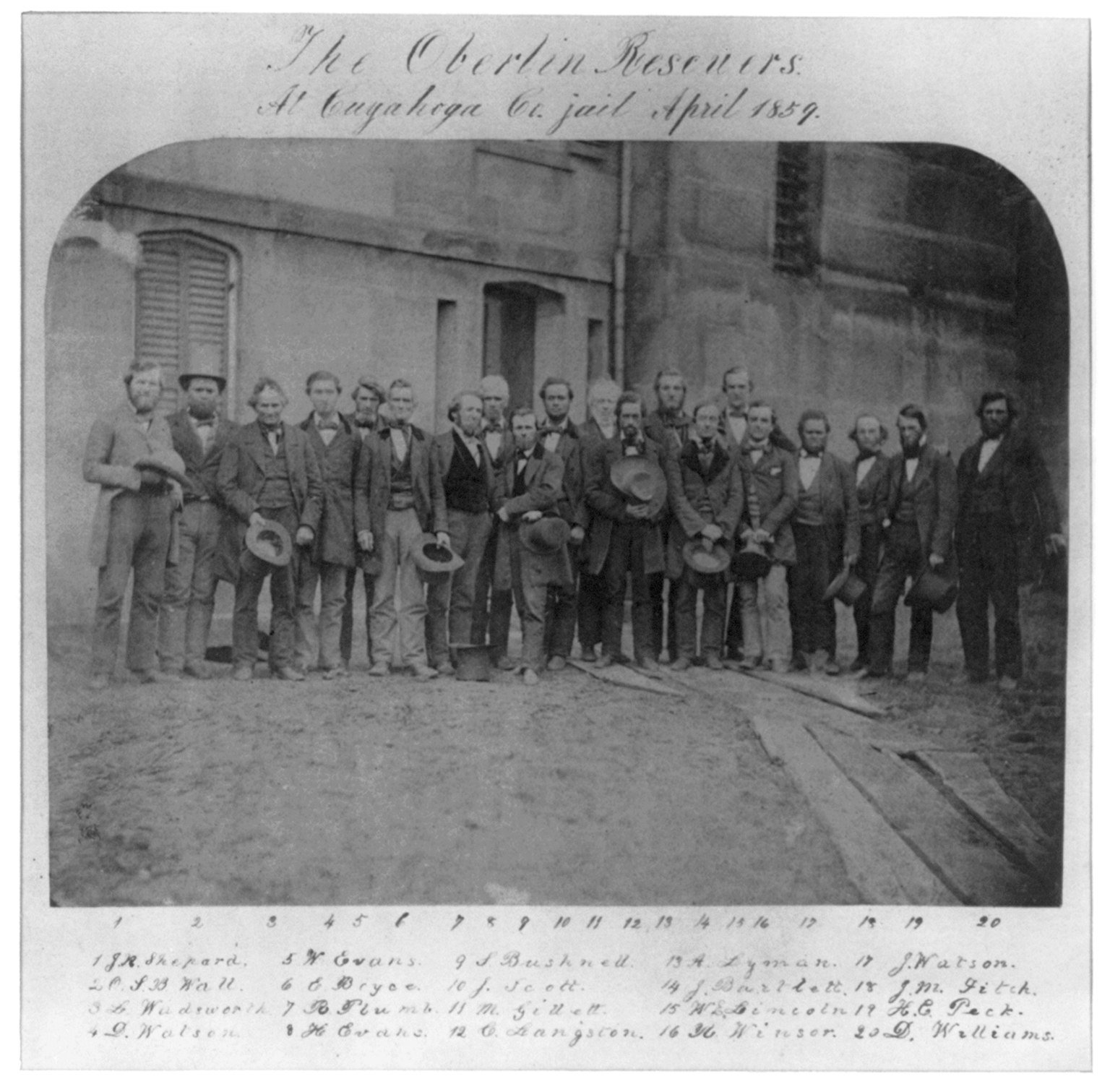
On September 13, 1858, slave catchers seized a man named John Price outside Oberlin and held him at a hotel in Wellington. A crowd from Oberlin followed. Wilson Bruce Evans and John Anthony Copeland were among the men who forced their way in. Price went out a window, into hiding, and on to Canada. No one was hurt.
The federal government indicted 37 people under the Fugitive Slave Act. Both Evans brothers were jailed in Cleveland. Wilson Bruce Evans spent 83 days in the Cuyahoga County Jail. His case was never heard.
Harpers Ferry
3 months after the rescuers came home, Lewis Sheridan Leary and John Anthony Copeland left Oberlin to join John Brown. Leary left behind his wife Mary and a 6 month old daughter. On October 16, 1859, they were part of the raid on the federal armory at Harpers Ferry, Virginia.
Leary was shot trying to cross the Shenandoah River. He lived about 8 hours and sent word home. He was buried in a box by the river with 7 other raiders. Copeland was captured, tried, and hanged at Charlestown on December 16, 1859, beside Shields Green. Medical students dug up both bodies for dissection. Virginia’s governor would release Copeland’s body only to a white person. His family never got him back, and Oberlin held his funeral over an empty coffin.
John Brown and Timbuctoo
Brown had moved his family to North Elba, New York, to live beside Timbuctoo, a settlement of Black farmers on land granted by Gerrit Smith. Most white abolitionists of his day wanted slavery ended and still would not eat at a table with Black people. The Browns did. 2 of his sons, Oliver and Watson, died at Harpers Ferry. In 1899 the remains of the raiders buried by the Shenandoah were carried to North Elba and laid beside John Brown.
Why the shirts
Leary Evans was started by Lewis Sheridan Hughes, a descendant of the Evans and Leary families, named for the man shot in the Shenandoah. Every shirt carries a real person and a true line. The history is not hopeful. It is a record.
The art
Every portrait starts from a real photograph of the person. Some are printed as the photo itself. Others are made in the spirit of 3 Black artists whose work shaped how this country sees Black struggle: the linocuts of Elizabeth Catlett, the posters of Emory Douglas, and the paintings of Jacob Lawrence. Their names appear in small print on those designs as an honor to them.
Leary Evans is not affiliated with or endorsed by Elizabeth Catlett, Emory Douglas, Jacob Lawrence, or their estates.